Hotel Photography Checklist for OTAs and Websites
Plan hotel photography for factual OTA evidence, website storytelling, accessibility, usage rights, and web performance.
Quick answer
Create one current master photo library, then select and crop assets for each channel. OTA galleries should make every room, bathroom, amenity, exterior, and material access detail easy to verify. The official website can add people, sequence, video, and local story, but it must remain accurate, permissioned, responsive, and fast.
Editorial note: Reviewed on 18 August 2026. Image dimensions, file types, ordering tools, overlays, and moderation rules differ by platform and may change. Check each live extranet before export; the numeric specifications below refer only to the cited Google and Airbnb guidance.

📖 On this page (Table of Contents) ▼
What should a hotel photography checklist include?
Cover the complete stay first, then create channel variants. Guests need to verify the room, bathroom, shared spaces, location context, and accessibility before they need a cinematic brand story.
Google’s current Hotel Center guidance recommends 2048 × 1366 pixels, accepts JPG, JPEG, WEBP, and PNG up to 10 MB, and requires at least 1024 × 683 pixels for its lodging photo feed. Airbnb’s current host guidance recommends horizontal high-resolution images and context-rich room tours. Other OTAs have their own live rules, so confirm them in the extranet rather than applying these numbers universally.
Build the master shot list
Property and arrival
- exterior from the real guest approach;
- entrance, reception, parking, drop-off, and signage;
- day and night context when both materially affect arrival;
- steps, ramps, thresholds, corridors, lifts, and accessible routes;
- pool, dining, spa, gym, work, event, and family spaces that are actually available.
Every sellable room type
- a wide view from at least two useful positions;
- the full bed and sleeping layout;
- bathroom with fixtures, floor, and access visible;
- balcony, terrace, window view, desk, seating, storage, and relevant amenities;
- connecting-room or extra-bed configuration when sold;
- accessibility features and transfer space where applicable.
Service and story
- current food and beverage experience;
- team and service moments with permission;
- architecture, materials, art, and local context;
- nearby experiences the hotel can accurately support;
- seasonal conditions when the stay changes materially.
Select OTA images for comparison
OTA galleries are usually viewed as thumbnails and room-level tours. Prioritise unambiguous images that help a traveller compare:
- a truthful lead image that represents the property;
- room-category images assigned to the correct room;
- the bathroom and full sleeping layout;
- material amenities, view, and access constraints;
- shared facilities and exterior context.
Avoid distortion, excessive filters, tight crops that hide layout, collages, and graphics that can be mistaken for part of the property. Google advises natural brightness, straight lines, realistic colour, no dramatic filters, and no added elements. Airbnb advises straight horizontal framing, natural light, a mix of wide and detail shots, and captions that explain layout.
Select website assets for a guided story
The official website can arrange the same evidence around a guest decision:
- lead with the strongest accurate stay promise;
- follow with the relevant room and bathroom proof;
- explain location, dining, service, and experience;
- use people only with releases and in contexts that remain representative;
- link each gallery or campaign to live availability for the shown room or package.
Video can add atmosphere, but it should not block the core answer or booking action. Provide a poster image, avoid unexpected sound, respect reduced-motion preferences, and let the page remain useful if the video does not load.
Prepare delivery files for speed and reuse
Keep an archival master and generate channel derivatives. For the web:
- export responsive widths close to actual display sizes;
- use a modern format when supported and retain a suitable fallback where needed;
- set intrinsic width and height or aspect ratio to prevent layout shift;
- preload only the true largest-content image;
- lazy-load below-the-fold galleries;
- write alt text for the image’s purpose and keep decorative assets empty;
- record photographer, licence, subject release, property, room, shoot date, and expiry review.
Do not embed the only copy of an asset inside a social post or OTA. Maintain a searchable source library with stable names.
Run a pre-publish accuracy check
Ask rooms, operations, revenue, accessibility, and marketing owners to sign off:
- every image matches the named property and room category;
- features shown are available under the stated conditions;
- renovations, removed amenities, and old brand elements are gone;
- captions and alt text do not add unsupported claims;
- asset rights and guest permissions are recorded;
- crops work on small mobile cards and large screens;
- the live page is checked for image size, LCP, CLS, broken sources, and missing alternatives.
Measure business use, not a generic conversion claim
Tag major gallery changes and compare room-page engagement, booking-engine progression, confirmed bookings, cancellations, and photo-related questions before and after. Use a comparable period or controlled test where possible. Do not attribute every change to photography when price, inventory, demand, or policy changed at the same time.
Sources and references
- Photo recommendations and best practices, Google Hotel Center Help.
- Provide and manage images for hotel listings, Google Hotel Center Help.
- How to take great photos for your listing, Airbnb Resource Center.
Is Your Hotel's Digital Presence Working for You?
❓Frequently Asked Questions
About the Author
The ScaleMyHotel editorial team publishes practical guidance for independent hotels. Articles separate definitions from recommendations, label illustrative examples, and are reviewed against the cited sources and the product or platform interfaces available at the time of publication.
More Hotel Growth Guides
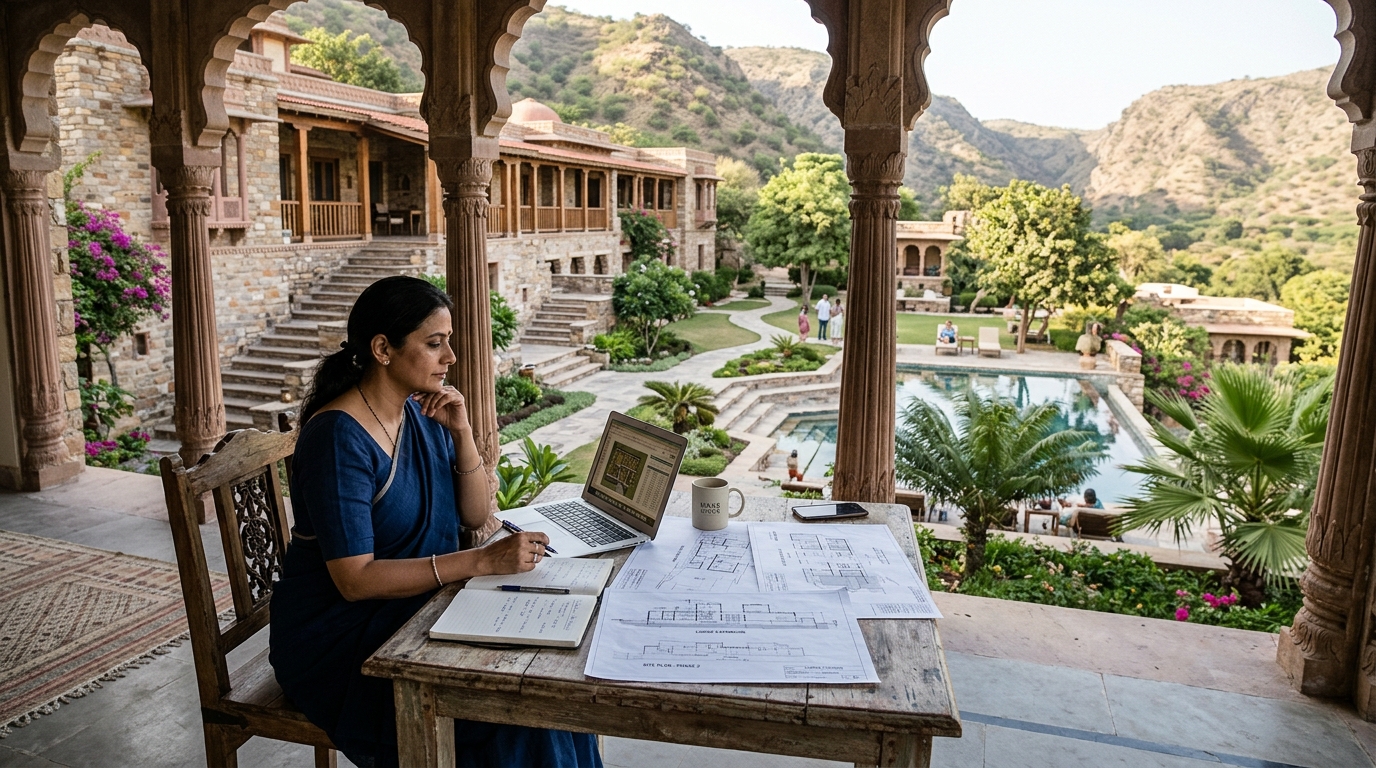
Should You Build a Boutique Hotel in India? A Practical 6-Part Opportunity Test
A practical six-part framework for evaluating a boutique hotel, resort, villa or hospitality conversion in India, including an illustrative 12-room break-even model.

Attract International Hotel Guests to India
Position your Indian boutique hotel or heritage resort to attract high-ADR inbound travelers from North America, Europe, and the Middle East.

Bali Villa Marketing for More Direct Bookings
Build qualified direct demand for a Bali villa while measuring channel contribution and preserving useful OTA demand.

Hotel Email Win-Back Sequences That Respect Consent
A practical hotel email framework for abandoned bookings and past-guest win-back campaigns with consent, suppression, and contribution measurement.

Hotel Instagram Marketing in India: A Booking Funnel
Turn original hotel content and profile proof into qualified Instagram enquiries, then measure confirmed bookings.

Boutique Hotel Marketing in India: A Practical Plan
A measurable marketing plan for Indian boutique hotels built around positioning, demand capture, proof, direct conversion, and repeat stays.